
Blessed are the Eyes that See
Luke 10:23-37
August 30, 2026 anno Domini
“Blessed are the eyes that see what you see!”
What have you seen? What did the disciples see that prophet and Kings (those OT folks) longed to see? They saw the Guy standing in front of them who spoke that blessing – they saw Jesus. They saw the Son of God in the flesh and they beheld the power of His Word.
Luke chapter 10 begins with Jesus sending out 72 men to proclaim His Word of peace. You might remember this sending. Jesus says the harvest is plentiful but the workers are few. He encourages praying for more workers. He told His men not to take anything with them. Where the Word was received, they were to stay. Where it was rejected, they were to leave, shaking the dust off their feet. Jesus told these 72 that He was sending them as lambs among wolves, but this time the lambs won.
Right before the text the 72 return with great joy – proclaiming that even the demons were subject to them in Jesus’ name! Jesus says that while they were out preaching, He “saw Satan fall like lightning from heaven.” Their preaching was toppling Satan, but Jesus warns them – not to rejoice in their power over Satan and evil, but rejoice that their names are written in heaven.
This is what the disciples saw –Jesus at work through His Word – scattering demons, beating evil, bringing peace to people in chaos. They saw the Word work. Then Jesus warns them – not to rejoice in all that they did in Jesus’ name, but rather to rejoice that their names were written in heaven.
That serves as a fitting introduction to the story of the Good Samaritan, because with a man rejoicing in what he can do, rather than in rejoicing in Jesus.
A lawyer stood up to put Jesus to the test, saying, “Teacher, what shall I do to inherit eternal life?” It’s a great question. Did you think at all about eternal life this week? If you want to know about eternal life there is no better person to ask than Jesus. He knows the way because He is the Way.
Saint Luke lets us know that the lawyer doesn’t want to listen to Jesus; he wants to teach Jesus. Teachers give tests and that man thought with his test he would teach Jesus a thing or two. Good luck with that.
Jesus then asks the Lawyer, “What is written in the Law? How do you read it?” Notice how Jesus has already taken the role of teacher. The lawyer responds, You shall love the Lord your God with all your heart and with all your soul and with all your strength and with all your mind, and your neighbor as yourself. The lawyer gets an A from Jesus. “You have answered correctly; do this, and you will live.”
So. here’s the way to eternal life according to Jesus. Keep the Law perfectly and God will welcome you into heaven. Love God above all things with everything you have. And love your neighbor – honor your parents and other authorities, don’t hate anyone, reserve sex for marriage, take care of whatever you own and respect what your neighbor owns, don’t lie, slander, betray, be content with what the Lord gives you. Always, with everything you have and are – love God and your neighbor. That’s all you need to do to be in heaven. The only fitting response to those words is “Lord, have mercy on me a sinner.”
Jesus tested the lawyer with His question and the lawyer failed the test – Saint Luke tells us that the lawyer, desiring to justify himself, said to Jesus, “And who is my neighbor?” Do you remember how you reacted when you did poorly on a test in school? You argued with the teacher. You defended your answer. You took consolation that you did better than others. You tried to justify your answer. The Lawyer cannot pass Jesus’ test – do this, love God and man perfectly, and you will live, so he tries to lower the bar – do a little commandment adjustment. Which of the commandments do you adjust to justify yourself? Repent.
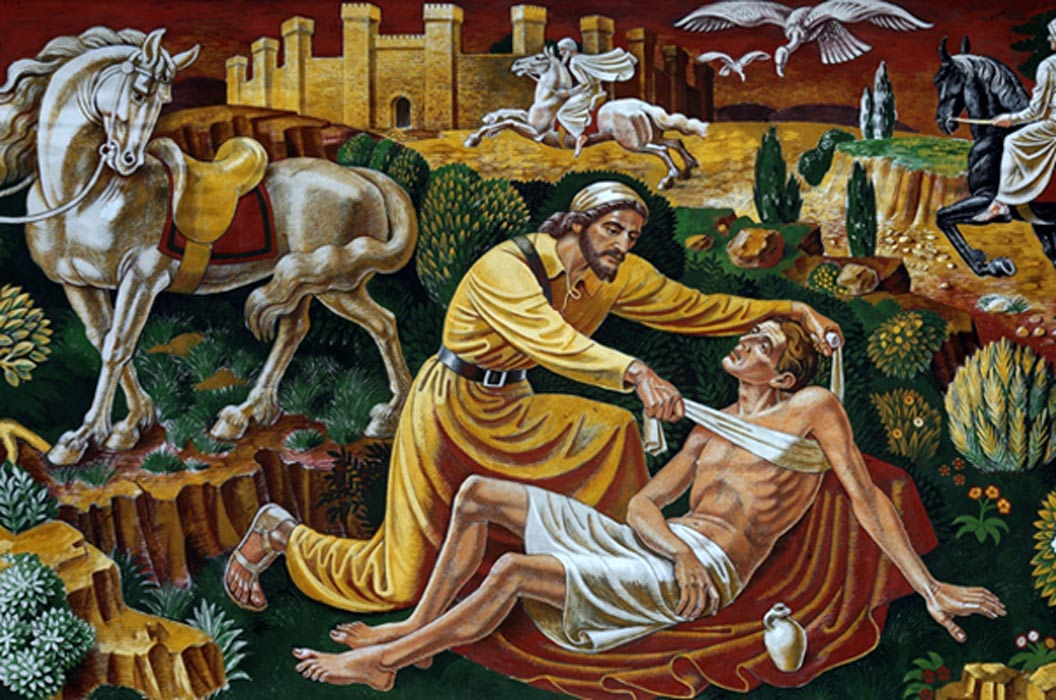
In order to teach the man the way to eternal life, Jesus tells the story of the Good Samaritan. It’s a parable so there’s more to the story than meets the eye.
On the surface the Good Samaritan preaches the harsh and strict Law of God for that self-justifying lawyer. The message of the parable for him is that his neighbor is any person near him who is in need. The religious priest and Levite are convicted for their lovelessness and the Samaritan is an example of mercy that shames the priest, the Levite, the lawyer and us. The message for the Lawyer is – you are not merciful. You want to pick and choose your neighbors and only love those who are lovely to you, who could repay you in some way. Repent.
Beneath the surface the parable is the sweetest Gospel for you, especially if you have not loved as you should. Allow me to show your eyes something you may not have seen in this parable. By the way, I didn’t dream up this interpretation. The early church fathers – guys with names like Ambrose and Origin and later Augustine – looked on the parable this way.
The man in the parable is Adam, who by his sin left paradise, represented by Jerusalem. He went down, travelling the road of disobedience. The robbers are the curse of sin – they beat us up and leave us half-dead – actually all the way dead unless someone stops to help us. The priest and the Levite represent the law. The law cannot save you. When Jesus says, “Do this – keep the law, and you will live,” that is a death sentence for sinners. Through the Law and the troubles of life God lets you feel the curse of sin. The Law is a like a news reporter detailing the disaster you’re in, but not offering to help. The Law reports what happened – Those robbers stole your billfold, smashed your phone, burned your car, and left you on a gravel road in rural Stearns county, in a blizzard. You’re a dead man. I sure hope someone comes by to help you but that’s not my job.
Enter the Good Samaritan who by now you should recognize as Jesus. He anoints you with oil, which historically was used in baptism, and wine, which is used in Holy Communion. He loads you on His beast and carries you to the inn – the church – where He provides everything necessary for you to be healed from the curse of sin.
Even the two coins the Samaritan gives to the innkeeper have a connection to the saving work of Jesus. A denarius is a days wage, which hints that the Samaritan will return on the third day and then He’ll use His platinum visa to pay whatever is owed to heal the beaten and robbed man. Now that surely sounds like Jesus to me. Declaring on the cross that “It is finished” and returning on the third day to proclaim – your sins are forgiven, the curse is removed, you are alive, the resurrection and perfect healing await.
Here is what I want you to see this morning so that you are blessed. See the harshness of the Law. Hear Jesus say, “Do this and you will live” and confess that you have not done this – you have not loved God with your whole heart and not loved your neighbor as you should. You are the Levite and the priest who walked by.
Then see the mercy of God in the Good Samaritan. Jesus walked the road down from heaven, onto your cursed and battered road. He picked up your flesh in His conception and carried your sins in His body to the cross. He paid the full price for your salvation and returned on the third day. In the inn of His church He forgives, heals, comforts, and strengthens you.
Finally I would have you see this – to quote John the Apostle, we love because He first loved us. The story of the Good Samaritan doesn’t just convict us of our sin, and comfort us with Jesus, it also guides us to love God and our neighbor.
Blessed are you when your eyes see this. In the name of Jesus. Amen.