
Five. Two. Twelve.
John 6:1-15
March 15, 2026 anno Domini
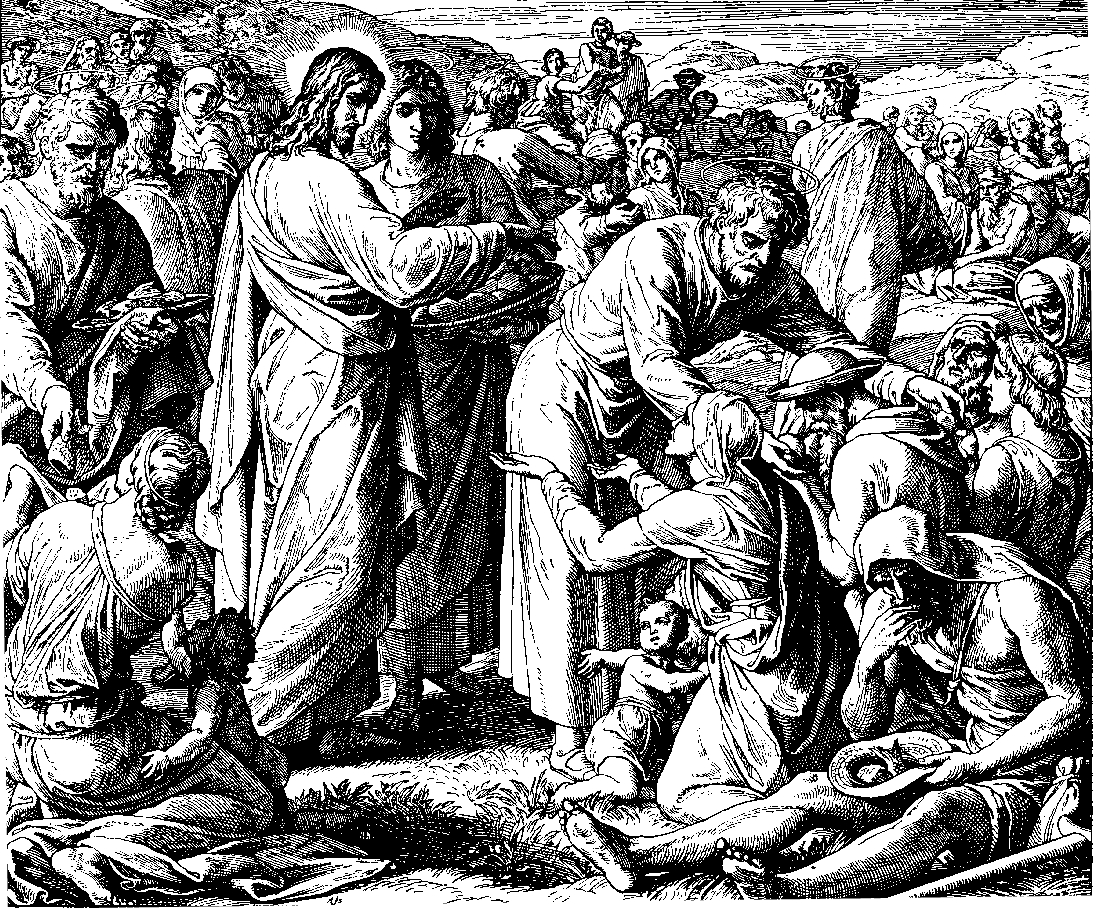
Five loaves of bread. Two fish. Twelve baskets of leftovers.
The church fathers loved to allegorize with these numbers. Five plus two is seven – that’s the days of creation and here we see Jesus with power over creation. He multiplies the bread and fish likes He makes a single seed produce 100-fold. Five times two equals ten and that’s the number of the commandments. Moses received the commandments on a mountain and Jesus fed the crowd on a mountain. While Moses was on the mountain the Israelites had an affair with the Golden Calf – eating and drinking and playing. When Jesus is on the mountain the crowd wants Jesus to be their belly god. They too want an idol, not the true God. Five is the number of the books of Moses. You should definitely know the books of Moses. But there are two Testaments. So, in the New Testament you should at least know Matthew, Mark, Luke, John, and Acts. Twelve is the number of the tribes of Israel and also the number of the Apostles – it’s the number of the church – those faithful to God. Which probably means you should know the whole Bible, not just five books in each Testament.
Five. Two. Twelve. There’s enough right there for a sermon – and that’s without talking about 200 denarii or 5000 men being fed.
Running the numbers through the Bible is a good exercise for your knowledge and your faith, but don’t do so at the expense of the actual words of Scripture.
This miracle, the feeding of the 5000, is the only miracle recorded by all four Gospel writers. And they all record the same basic details. The crowds had followed Jesus because of His miracles. It was supper time. They were near enough to some towns where they could have gone and gotten some food – probably like tour buses pulling into a restaurant at closing time – it would have worked – sort of. According to Matthew, Mark, and Luke that was what the disciples desired – send them away. Only John records the conversation between Jesus, Philip, and Andrew.
Jesus said to Philip, “How are we to buy bread, so that these people may eat?” This was a test and it seems that Philip failed the test. He must have asked the disciples how much money they each had. Between the 12 of them they had 200 denarii, but that would not buy enough food for 5000 men. Andrew also fails the test – there’s a small boy with his family’s picnic lunch – five little barley loaves and a couple salted fish, but what are they for so many?
I doubt if we would have done any better than Philip or Andrew. Like them we look to ourselves first. It’s what we do. What am I going to do? How am I going to handle this? How would Philip have passed the test? Perhaps he should have said, “Well Jesus, you’re here, so if these people are going to eat that’s on You.” Or Andrew might have passed the test by saying, “Lord, I remember how you changed water into wine, here’s five loaves of bread and two fish. With You, that’s more than enough to feed this crowd.”
The miracles are meant to show us that Jesus of Nazareth is the same God who created the heavens and the earth, who brought Israel out of slavery, who rained down manna from heaven and brought quail on the wind to feed His people.
The miracles also show us what sort of a god the God of Scripture is. He is a God of love and mercy. The feeding of the 5000 was not a miracle of necessity – it sounds like they crowds could have made their way back to town and gotten some food. Gas station food isn’t the most satisfying or nutritious, but it will do in a pinch. This is not a miracle of necessity like casting out demons or giving a blind guy sight. This is a miracle of kindness.
This miracle shows Jesus is God and that He is compassionate, but Saint John tells us this miracle was done for other reasons. It was done to test the disciples. It was also done to reveal the hearts of the crowd. Only Saint John tells us that after the miracle the crowd was “about to take Jesus by force to make him king” so He “withdrew again to the mountain by Himself.”
Jesus did the same thing earlier in John’s Gospel. He was in Jerusalem at the Passover Feast, and many believed in Him because they saw the signs that he was doing. But Jesus did not entrust himself to them, because he knew all people … he himself knew what was in man.
Jesus knew what was in man. He knows what is in you. What do you want from Jesus? What do you pray for? Are your prayers for bread, for miracles, for signs that satisfy you? You know what’s in your heart – you are.
Jesus would give you more. There were 12 baskets of leftovers. Jesus left the crowds because He wanted to give them more than a belly god.
Do you remember the first temptation of Jesus in the wilderness? He was having His own Lent – forty days and forty nights of fasting. Satan tempted Him to turn stones into bread, feed Himself. Use His Divinity to feed His starving humanity. How did Jesus respond? “man does not live by bread alone, but man lives by every word that comes from the mouth of the Lord.”
That’s another difference between John’s Gospel and the other Gospels when it comes to this miracle. In John’s Gospel the miracle ends with words, lots of words, dare I say, more than twelve baskets full of words.
When the crowds pursued Jesus to the other side of the sea of Galilee Jesus gave them words, “Truly, truly, I say to you, you are seeking me, not because you saw signs, but because you ate your fill of the loaves. Do not labor for the food the perishes, but for the food that endures to eternal life, which the Son of Man will give to you.”
What is that food? It is Jesus. He gives them more words in John 6, “I am the bread of life, whoever comes to me shall not hunger and whoever believes in me shall never thirst.” Later He says, “Whoever feeds on my flesh and drinks my blood has eternal life, and I will raise him up on the last day. For my flesh is true food and my blood is true drink.”
The crowds want bread. Jesus has come to give life. They want a full belly. He will give them a new heart that beats with eternal life. We are hungry and thirsty because everything we eat is dead or dying. He would give us His body and His blood, the same body and blood that died on the cross, that rose from the dead and now sits at God’s right hand. The food in this supper forgives, lives, and rules.
Jesus would feed you Himself. He knows what is in you – sin, selfishness, and death. And like the disciples with their 200 denarii and the little boy’s lunch of 5 loaves and two fish, nothing you have can meet your needs, or satisfy your desire to live. You need forgiveness and Jesus accomplishes it on the cross. You need life and He rose from the dead. You are hungering but no earthly indulgence will satisfy you and you know it. So, look to Jesus. He took that bread, broke it, gave thanks, and his men distributed it to those 5000 men. And what happened? They ate, as much as they wanted, till they were full. That’s what He’ll do for you when you believe in Him, when You take Him at His Word, when you eat His body and drink His blood. You will have life and have it to the full. In the name of Jesus. Amen.
I love this Sermon. You made it so very much for today. Thank you.