
 Good Question
St. Luke 10:23-37
September 6, 2020 anno Domini
“What must I do to inherit eternal life?” It’s a great question. What must I do to be saved? How can I be delivered from my troubles, my soiled conscience, my dying body? Did that question cross your mind once this past week? Did you give a minute’s consideration to eternal life or to looking to Jesus for help?
It is a good, right, and salutary question, but it comes from a Lawyer so Jesus is on guard. Not because he was a lawyer, but because Jesus knew his heart. He was testing Jesus. It’s like when your daughter says, “Dad, can I ask you a question?” She doesn’t want your answer. She wants her answer.
Jesus, being the teacher above all teachers, answers the question with a question. “What is written in the Law? How do you read it?” Like that Lawyer, most people think that if you are good you will go to heaven. How good? Above average, like most of us. C plus and above, when it comes to the commandments and Jesus will give you a passing grade and you’ll get into heaven.
But since when do students set the grading scale? This is Jesus’ classroom. The Lawyer wants the teacher Jesus to tell him how good he is. He thinks he’s A+ material, but he’d take an A from Jesus. Unfortunately for him (and for us) Jesus fails anyone who thinks he is good.
Jesus is true God so Jesus asks the Lawyer, “What is God’s definition of good?” Since the Law of God is good and wise and sets God’s will before our eyes, what does it say? The lawyer delivers an excellent summation, “You shall love the Lord your God with all your heart and with all your soul and with all your strength and with all you mind and your neighbor as yourself.” Love has nothing to do with what’s in your heart. Love is not an emotion towards someone else. Love is external, aimed at others, with all you have – all your heart, soul, mind, and strength directed to God (that’s commandments 1-3) and your whole body – male or female, hands, mouth, ears, feet, serving your neighbor. (That’s 4-10). The Lawyer gets an A plus for his summary. “You have answered correctly.”
Then Jesus gives the Lawyer an F for failure to keep the Law. “Do this, and you will live.” The Lawyer was testing Jesus. He thought he was good. He was the student who always wanted to impress the teacher and his classmates with his wisdom. And there was no better moment than when the teacher put Mr. Smarty pants in his place. If you think you are good and you can earn heaven – here’s the test – keep the Law, every commandment, with your heart, mind, soul, and body. “Do this, and you will live.”
When you got a poor grade on a test the first step is to argue with the teacher, try to justify your answers, wrestle a few points out of him to get your grade up. The poor lawyer tries that on Jesus. Desiring to justify himself he said to Jesus, “And who is my neighbor?”
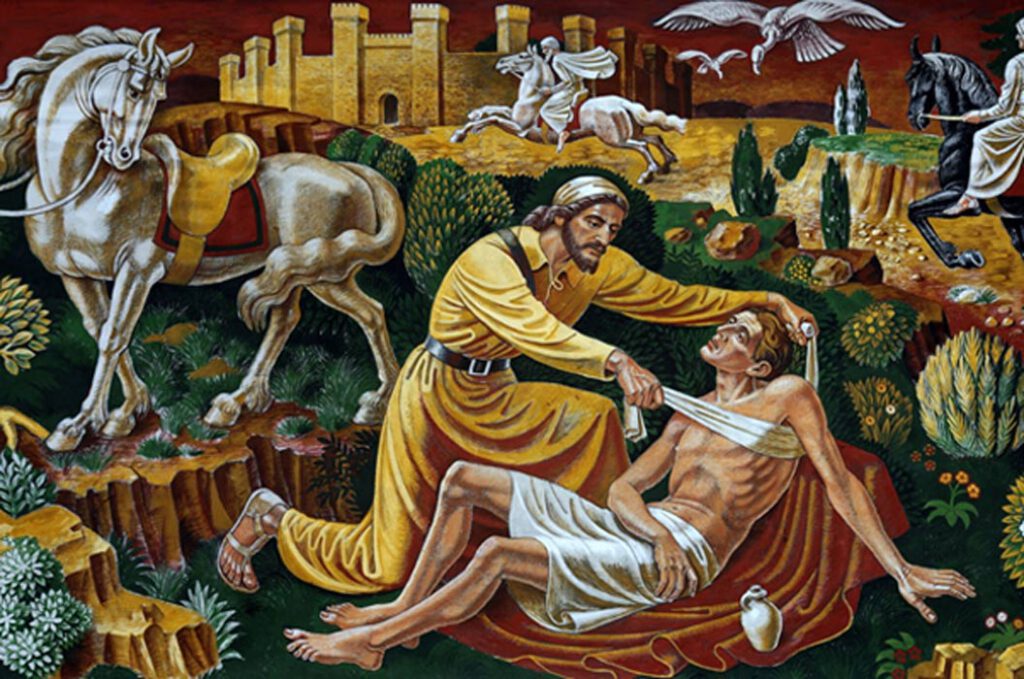
In response Jesus tells the parable of the Good Samaritan. This morning I’m going to have you look at that parable in a different light – as an allegory. By the way this isn’t something I dreamt up this week in my office. The early church fathers – guy with names like Ambrose and Origin and later Saint Augustine – looked on this parable as an allegory.
Here’s the allegorical interpretation. The man is Adam, who left paradise (Jerusalem) by his sin and traveled the downward road of disobedience. The robbers are the curse of sin – they beat us up and leave us half dead (actually all the way dead – if the Good Samaritan doesn’t save us). The priest and the Levite represent the law. The Law cannot save you. It passes at least six feet away from you, keeps it mask on, and says, “I can’t help you – that’s not my job.” God did not give His Law so you could pull yourself out of trouble and climb back on the road to life. These robbers stole your billfold, took your cell phone, burned your car, and left you on a gravel road in rural Benton County naked, in a blizzard. You cannot save yourself. Someone better come along and quick.
Enter the Good Samaritan – who by now you know is Jesus. He anoints you with oil (which used to be used in Baptism) and wine (which is still used in the Lord’s Supper. He loads you on His beast and carries you to an inn (the Church) where He provides all your needs.
Now here is where the allegory gets even more interesting. The Good Samaritan hands over two denarii to the innkeeper. Promising to return and pay anything owed for the beat up guy. Along with the denarii he handed over his platinum visa and said “Rack it up, whatever the guy needs I’ll pay, when I return.” In the days of Jesus a denarius was one day’s wages and also the cost of one night’s lodging. That makes sense – what you need to live for a day is the cost of a bed and breakfast for the night. So the Good Samaritan is going to be gone two nights and when He returns on the third day He will pay for everything the beat up man owes. Sounds like Jesus to me.
So the answer to “What must I do to inherit eternal life?” is “Be rescued by Jesus.” In order to be rescued you need to feel that your sin has beat you and left you half dead. You need to see the Law as helpless to save you. It cannot pick you and carry you to salvation. You’re in no condition to walk the road back to the heavenly Jerusalem. Jesus has come. He carried you Himself. He was the beast of your burden as He carried your sins to the cross. Three days later He returned with His abundant forgiveness. Jesus’ forgiveness is not stingy. He doesn’t say, “I’ll give that beggar a dollar so I can buy a five dollar cup of coffee for myself at Starbucks.” There is no limit to His compassion for you or His forgiveness. He pays the price for your first sin and worst sin and your pet sin that has you wrapped up and on the verge of falling.
This parable may be allegorical. But Jesus’ last words to the Lawyer are not, “Go and do likewise.” The Son of God had one purpose in being conceived by the Holy Spirit and being born of the Virgin Mary. He wants your name to be written by His blood in the book of life. He wants you to live – and that isn’t some far distant life of the resurrection. That’s right here and right now. Jesus carried us dead sinners to the inn of His church to resurrect us, to heal us, to cleanse our consciences, and make us alive again. Pardon the allegory, but He didn’t do this so we could sit in the inn, empty the mini bar, and rack up charges on His visa. Go, and do likewise. Live like you’ve been raised from the dead. When you see someone else beaten by the curse of the Law and left half dead, forgive them, have compassion on them, help them up. That doesn’t mean you need to go looking – your neighbors are those who are nigh unto you – nearby. Your nearest neighbors are your family – your sister who has been beat up, your nephew who has fallen in the ditch, your son who has left the church and doesn’t know he’s been robbed. Your grandchildren who are walking to Jericho and don’t even know it. Your family is likely filled with lawyers who think they are above average in the eyes of God, but don’t know that if you get one commandment wrong you’ve failed. Jesus is the Good Samaritan who came along to rescue you from the curse of sin and death. He spared no expense for you. Go and do likewise, not to inherit eternal life, but because are alive. In the name of Jesus. Amen.