
 Jesus says, “I Will”
Matthew 8:1-13
January 26, 2020 anno Domini – Redeemer
“I will.” Last week Jesus was at the wedding in Cana. “I will” are wedding words, but Jesus isn’t at a wedding this week. He has come down the mountain where He had been preaching and teaching the Sermon on the Mount. He ran into a leper and then a Centurion with a dying servant. He left church and immediately found suffering, loneliness, sickness and death. That’s what you’ll find when you leave here this morning. To the leper and to the Centurion Jesus says, “I will.” Those are wedding words. They are promise words. Jesus will save. Jesus will heal. Jesus will resurrect. The leper. The dying servant. You.
When you get married according to the rite of the church you don’t say, “I do.” Do you love her? Do you love him? I do. Love is easy when you’re young and healthy and life is all ahead of you. Love is easy when you’re dating and both of you are trying to win the other over and tenderly avoiding any conversational explosions. That sort of love requires very little. At that point you’re receiving more from your marriage than you are putting into it.
It is not easy to love the unlovable, the husband who leaves you alone, the weird and demanding parent, the child who rebels, the wife who is bored with marriage and the kids and wants a real life. It is not easy to love someone who is repulsive. In your weddings vows you say “I will” because that is exactly what you are promising. You will love in sickness, in poverty, in the worse times, because the love of marriage is a dim reflection of God’s love for you in Jesus. Jesus says “I will.”
“And behold, a leper came to him and knelt before him, saying, “Lord, if you will, you can make me clean.” The Leper knew he was repulsive and unlovely. His fingers were falling off, one of his ears was missing, he was nearly blind, he looked like a Zombie and leprosy was highly contagious. Would you want to visit someone like that, with a mangled, grotesque body and a communicable disease? No thanks. Jesus says, “I will.” He stretched out his hand and touched (the leper), saying, “I will; be clean.” And immediately his leprosy was cleansed.” (Matthew 8:2–3, ESV)
Our sin is like leprosy. Sin isolates you from other people. Sin makes you unlovable. Sin spreads from parent to child by nature and from neighbor to neighbor by nurture. You can see the outward effects of sin and the damage it does to us and others. Your sin makes you repulsive in the eyes of God, and yet because God is love He loves you in this way. In Jesus He says, “I will” and it is not like so many of our human promises and words. I have said, “I will,” but then I didn’t. I promised I will but then I make excuses when I won’t. God said, “I will send the son of a woman to crush the serpent’s head, to forgive your sins, to love you by making you lovely again so you can be with me forever,” and then He did what He willed. Jesus is God’s “I will” to you.
God said, “I will crush Satan” and Jesus did so, by never sinning, by obeying His Father above instead of the father of lies. God said, “I will take away your sin,” and Jesus did, by bearing your sin in His flesh and suffering hell in your place. God said, “I will give you life” and Jesus did. “Whoever believes in me, though he die, yet shall he live.” (John 11) God said, “I will deliver you” and Jesus did by His death and His resurrection. Jesus will finally deliver you on the last day when He comes to take you home with Him, to behold Him face to face.
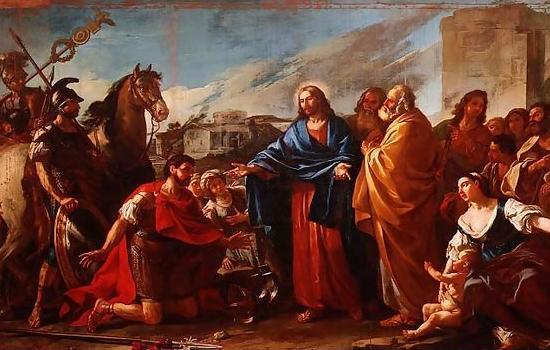
Jesus goes from loving the unlovable to facing death. “When he had entered Capernaum, a centurion came forward to him, appealing to him, “Lord, my servant is lying paralyzed at home, suffering terribly.” (vs 5–6) In 1st century Judea you couldn’t call the ambulance. There was no Centracare hospital with doctors and drugs and surgeons who could work miracles of healing. You could do nothing when death came. Even with all the faith we put in God’s gift of medicine you still can do nothing when death comes, but Jesus will. Jesus said to him, “I will come and heal him.”
Here the story takes an interesting Epiphany course, revealing something we do not see apart from faith. But the centurion replied, “Lord, I am not worthy to have you come under my roof, but only say the word, and my servant will be healed. (vs. 8) This Centurion, a Roman soldier and citizen, a Captain of about 100 soldiers, respected by the people he serves, and worthy in their eyes, says, “I am not worthy.” You are all good people in the eyes of the world, even in my eyes, but Scripture teaches that not one of us is worthy of God’s love, His gifts, or His presence. We might look good, but by nature we are not good. So the good Centurion teaches us.
The Centurion was a great man on earth like Naaman in the Old Testament reading, but unlike Naaman he knew his place before the Lord. He was unworthy. He also believed the Lord’s Word carried authority. If the Lord says, “Dip yourselves seven times in the cesspool called the Jordan River and your leprosy will be healed” you will be healed. What the Lord says He does. What He promises He fulfills. If He says, “I will” He will. The Centurion believed and the Lord’s Word healed his servant.
Jesus marveled at the Centurion’s faith so it is not surprising that the Centurion’s faith was imitated in the life and liturgy of the church. Many Christians pray the Centurion’s prayer right before receiving the Lord’s body. “Lord, I am not worthy that you should come under my roof, but say the word and my soul shall be healed.” In the rite of private absolution, the Centurion is also imitated. After hearing the penitent’s confession the pastor asks, “Do you believe that my forgiveness is God’s forgiveness?” The penitent answers “yes” and the pastor says what Jesus said to the Centurion, “Let it be done for you as you believe.” Then absolution is pronounced.
How do you know that God will do what He says? How do you know Saint Cloud tap water cleansed you of your sin in baptism? How do you know it is Christ’ body and blood under the bread and wine? How do you know that He will never leave you or forsake you? How do you know that even though you die you will live? How do you know that whatever you suffer here on earth is but a slight momentary affliction when compared to the glory to be revealed on the last day? Because God promised “I will send my Son” and He did. Because Jesus said, “I will die and rise” and He did. We don’t just have promises in a book. We have facts in the flesh, the flesh of Jesus born of Mary, the flesh that died on the cross, and the flesh that rose again. We have unimpeachable witnesses to that fact that Christ was born, Christ has died, and Christ is risen.
It is one thing to say, “I will.” It is quite another to do what you promised. Our faith is not built on the hope that maybe God will love us and save us. Our faith is anchored on the solid rock that God did what He promised, that He said “I will” and He did. In the name of Jesus. Amen.