
The Jealous Jesus
John 2:13-25
March 4, 2018 – Redeemer
Jesus came to Jerusalem for the Passover from a wedding in Cana. He’s fresh off His first miracle which made everyone happy. Who wouldn’t be happy with 180 gallons of wine for the wedding reception? In Cana Jesus blessed a wedding couple with His presence, His first miracle, and He gave His mother and disciples a sign. Jesus is God – the God of creation, who made us and all things out of nothing, just as He made plain water into the greatest wine ever tasted on earth.
I think most of us would agree that we would rather have the Jesus of Cana than the Jesus of Jerusalem. The Jesus who brings gallons of wine instead of the Jesus who brandishes a whip. The giving Jesus instead of the angry Jesus. But you cannot have part of Jesus. If you pick the part of Jesus that pleases you, you’ll lose the part of Jesus that saves you. If you glory only in the giving Christ, you’ll despise the suffering Christ. So today we must follow Jesus away from Cana into Jerusalem, away from the wedding to the Passover.
But in a way Jesus is leaving one wedding for another wedding (or at least the anniversary of a wedding). The Passover Festival that was taking place in Jerusalem recalled that night long ago when God delivered His people, His bride from her captivity in Egypt. It celebrated the 10th plague in the days of Moses. In that last plague God sent His angel of death into Egypt. Death passed over every home where a lamb has been sacrificed and its blood was spread on the doorposts. Death visited every home not marked by the blood and killed the firstborn male. God did this because He had made a covenant, a sacred bond with Israel. When God told Moses that He was going to redeem His Israel He gave this vow to Moses to speak to the Israelites, “I will take you to be my people and I will be your God.” Sounds like a wedding vow to me.
In the text Jesus comes to His Father’s house, the temple in Jerusalem just days before the Passover. How does He see His bride being treated? How does He see His bride acting?
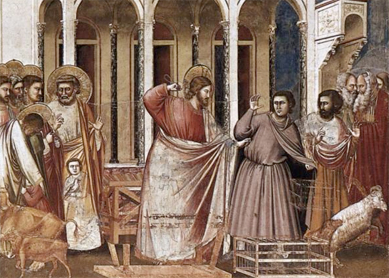
“In the temple he found those who were selling oxen and sheep and pigeons, and the money-changers sitting there.” (2:14) Right in the courtyard of the temple, there were oxen and sheep and pigeons and everything that comes along with animals standing around for a long time. (Think 4-H barns at the county fair.) Now those who were selling these animals for sacrifice were providing a convenience. The people did not have to drag an ox from Nazareth or keep pigeons cooped up all the way from Capernaum. No, now you could step right up, and purchase your pre-approved sacrificial animals right in the temple grounds.
The moneychangers also provided a service. Every Jewish male, age 12 and older, was required to pay a temple tax of ½ shekel. As they came from all over the world they needed to change their money into shekels, the only money accepted in the temple. The moneychangers conveniently served them.
Imagine the scene – in the temple proper the Levites are chanting the prayers and psalms. The priests are offering sacrifice. And in the courtyard business is being conducted. Since this God’s house we like to think that the sellers were fair and money changers were honest and God’s people respectful. And they were – probably about as fair as the movie theaters are when they sell popcorn. About as thoughtful as the people running for the door buster deals on Black Friday. Let’s face it, where sinners conduct business there will be greed. When you make a deal who do you want to benefit – you or the other person?
“And making a whip of cords, he drove them all out of the temple, with the sheep and oxen. And he poured out the coins of the money-changers and overturned their tables. And he told those who sold the pigeons, “Take these things away; do not make my Father’s house a house of trade.”” (John 2:15–16, ESV) Jesus tore into the temple like a jealous husband tears into the guy who is flirting with his wife, trying to lure her away.
So what does this text say to Redeemer? At times this text was used as the Reformation text. A Lutheran pastor could use these words to preach against Rome for selling of salvation in God’s house through Private Masses and Indulgences, but we’re not Roman Catholics. There are churches who function by a business model – make church convenient – serve coffee in the narthex, make the sanctuary a theatre, entertain with the screen, have the pastor stand up and give his one man comedy routine while some solo crooners inspire the crowd with love songs to Jesus. That’s not us either. For us it simply boils down to this – what business of yours gets in the way of God’s wedding feast? What business of yours keeps you from receiving the love of God in Christ Jesus? Maybe it is simply our busy-ness. Have you taken any extra time for devotions this Lent? Have you done anything to mark this holy season in your house or with your family? Or is it business as usual? What about the Lord’s day? Is your life like that parable in which the Master invites people to the wedding banquet of His Son, but everyone is too busy.
Jesus is a jealous husband – that also means He’s an angry husband – angry at everything that would take you away from Him. Angry when you would choose your business over Him. So picture when He comes home, to His Father’s house, and finds someone trying to take advantage of His bride, trying to lure her into false belief, putting obstacles in the way of His love for her. He sees her flirting. He tears the place apart. Whip in hand. Don’t mess with my beloved. Does Jesus get angry with you? Sure He does, especially when you fool around, because He loves you and because He alone gives you life.
The last week of His life Jesus would once again return to the temple and find exactly the same scene. He reacted the same way – turning over the tables, chasing the marketers out of the temple, chastising His bride for her adultery. A few days later everyone thought it would return to business as usual, because they had put Jesus to death.
Thanks be to God He operates by His own unique economy. He isn’t interested in what He can get out of you or how you can serve Him. His economy is Jesus. In His death on the cross, by bearing all your sins, your adultery and flirtation with false gods, your choosing to live for yourself instead of Him, He takes all that upon Himself and He dies for you. In so doing He says, “I take you to be my own and I will be yours.” Now that’s love – a man, the God-man, laying down His life for His beloved – for you, even though you’re not that lovely. He carries your sin, buries it in His tomb and covers it up. He rose from the dead, but will never resurrect your sin.
The Jesus at Cana is the very same Jesus at the temple– He has come give you what only He can give –forgiveness and life joyfully ever after. If you don’t think He’s serious about you look at the wedding, look at the temple, look at the cross, look at the empty tomb. In the name of Jesus. Amen.
Pr. Bruce Timm
March 3, 2018 anno Domini