
 Ashes and Your Reward
Matthew 6:1-6, 16-21
The ashes on your forehead preach a sermon – that’s all they do, but never underestimate a sermon from God’s Word. Whether you received ashes or not the sermon still stands. The ashes preach what you deserve – death. Dust you are and to dust you will return. “Earth to earth, ashes to ashes, dust to dust.” The wages of sin is death. If you’re a sinner you’ll die. If you’re dying then God is telling you something – you’re a sinner. We don’t want to think about that. We would rather believe it’s not going to happen – at least for a long, long time, so today God reminds us. The ashes will be on the heads of eight month olds and eighty year olds. Because of sin babies die and so do grandparents.
The other sermon on your forehead is your reward. Christ Jesus died for you. He took your sins to His cross and now He’s giving you a reward. Not an earthly reward based on what you did, but a heavenly reward based on what He did. The Holy Spirit delivers to you every reward Christ Jesus won on the cross – your sins are forgiven, your grave is only a dormitory – a place to sleep until you go to the home Jesus built, the house of the resurrected and living.
From the cross and under the cross you have Christ’s reward. With the sign of the cross your eternal life began in baptism. That sign begins the Divine Service, accompanies your absolution, blesses the Lord’s Supper, dismisses you from the Lord’s Table, and sends you on your way into the world when you leave the Lord’s house. Don’t miss the sermon that the sign of the cross preaches – sinners die, but Christ died for you so that your sins are forgiven. You don’t need to fear death. The resurrection is on the way.
We often think of Lent as a somber season, but it ought not to be. Throughout Lent we are moving toward the resurrection. Yes, there are calls to repent, to deny ourselves, to see the world in the reality of sin. All of this, including you and me, is passing away, but at the same time we are moving toward the resurrection. We are on our way to that Eternal Easter where sin and death and tears and sorrow are no more. That is our reward – the reward Christ won for us at the cross and gives to us in His house and which we receive by faith in His death on the cross.
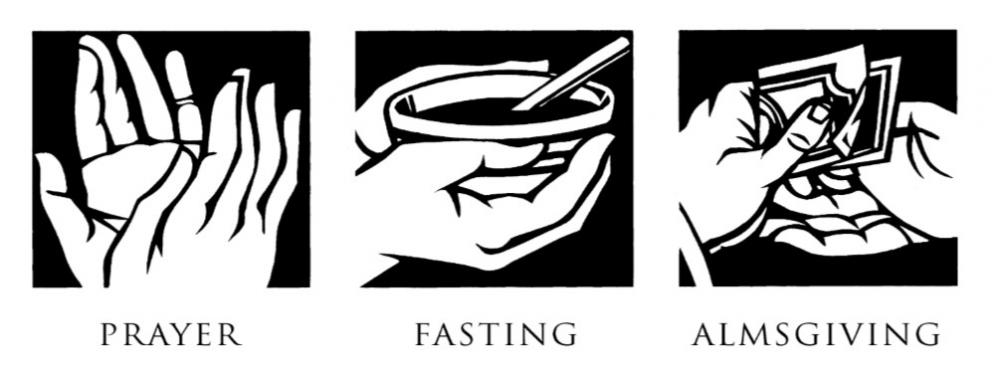
That sermon, preached not only in the Ashes, but preached every Lord’s Day in in the Holy Christian Church, sets the stage for three other common Lenten practices. Do you know the three practices that have accompanied Lent for almost 1600 years? Jesus speaks of all three in today’s Gospel reading. Almsgiving (Charity), Prayer, and of course Fasting.
Let’s start with the last one Jesus mentions first. “And when you fast, do not look gloomy like the hypocrites, for they disfigure their faces that their fasting may be seen by others. Truly, I say to you, they have received their reward. But when you fast, anoint your head and wash your face, that your fasting may not be seen by others but by your Father who is in secret. And your Father who sees in secret will reward you.” The first point Jesus makes about all of these habits of the Christian life is that you don’t do them so people see how good a Christian you are. If you fast, pray, or give to charity to get credit from others that is all the reward you’ll get. You’ll get earthly credit, maybe a deduction on your taxes, but that’s it. Good works will earn no part of your forgiveness and the resurrection to life. Your good works do not atone for your sin. That’s Christ’s work, that’s the cross and nothing else.
Why do Christians fast? Skipping a meal or giving up some food for the season helps us to practice what God’s Word preaches, “Man shall not live by bread alone, but by every word that comes from the mouth of God.” (Matt 4:4) Historically Christians gave up meat and dairy during Lent because those were luxuries. Fish was not a luxury. Now we have churches having fish fries during Lent to raise money – all you can eat. The most commonly practiced fast is to eat at the beginning of the day and at the end of the day and say “no” to that noon meal. Skipping that meal gives you extra time to meditate on God’s Word.
So let me ask you this. What could you give up this Lent that would save you time / and or money so you could spend more time in prayer, or give more money to those in need? Could you cut out restaurant meals? Get off Facebook? Shut down cable? Skip a meal a day? Lock away your screen? How could you say “no” to yourself so that you could say “yes” to more time in God’s Word or more gifts for your neighbor in need? That’s another aspect of fasting – as someone said it is exercising the “no” muscle. We love to say “Yes” to ourselves, but we believe as Christians we are to live not for ourselves, but toward Him who died for us, so we live disciplined lives, lives of self-control, controlling self by saying, “No” to something enjoyable, time-consuming, some luxury we could do without.
“And when you pray, you must not be like the hypocrites. For they love to stand and pray in the synagogues and at the street corners, that they may be seen by others. Truly, I say to you, they have received their reward. But when you pray, go into your room and shut the door and pray to your Father who is in secret. And your Father who sees in secret will reward you.” A few years ago, Pastor Matthew Harrison, President of our Church body, challenged everyone in the Missouri Synod to pray the Litany every morning during the 40 days of Lent. We prayed it today at the beginning of the service. It is a wonderful prayer that covers every situation and condition of man. You could use your service folder or find the litany in the hymnal and take up that challenge. One benefit of Lent is more time to pray. Every Wednesday at Redeemer we provide you with extra time to pray, by hearing God’s Word and praying Vespers at 4:30 or Evening Prayer at 6:30 pm. Those prayer services teach that prayer is not simply telling God what we want or need. First, we listen to His Word, we listen to His Son Jesus. After hearing Jesus speak we pray in Christ. By hearing the Word first our prayers are governed by faith not by feelings.
The last of the Lenten practices, which Jesus actually mentions first, is Almsgiving, charity, giving to others from all that the Lord has given you. “Thus, when you give to the needy, sound no trumpet before you, as the hypocrites do in the synagogues and in the streets, that they may be praised by others. Truly, I say to you, they have received their reward. But when you give to the needy, do not let your left hand know what your right hand is doing, so that your giving may be in secret. And your Father who sees in secret will reward you. In the Synagogues the offerings were often received in a container that had a brass or copper opening – perhaps it resembled the bell of a trumpet or trombone. As people threw their money in the coins clanged on the metal. Some people made sure they threw their coins in with extra force making sure their coins hit the metal so that everyone heard – listen to how much I’m giving. If the only reason you give to charity or to the Lord is for a tax deduction then that will be your reward. No amount of money will win God’s favor for you or open the door to heaven. It is God’s charity that saves you. He gave you, not silver or gold, but His Son’s holy and precious blood and His innocent suffering and death. You are forgiven your sins by God’s charity. The blood of Christ cancelled the debt and credited Christ’s righteousness into your poverty. So what will you give this Lent? Will you give up some luxury, cut out some costs, and practice a little self-denial, so you can give more to others? How about supporting our missionary Dr. Dan Jastram with a little extra this Lent?
Jesus said, “When you fast, when you pray, when you give.” Jesus expects that His disciples will practice what they believe — that we will exercise our faith by saying “no” to self, and saying “yes” to the Father in prayer and “yes” to their neighbor with charity. You have your reward. You have Jesus – the bread of life, the way to the Father, grace upon grace for you. Lent is a call to live as one who has been raised to life from death, even as we follow Jesus to death then life. In His name. Amen.
Pr. Bruce Timm